
How to Calm Reactive Dogs With Clear Structure
A reactive dog can turn a simple walk into a full-body workout. The leash tightens, your dog locks onto another dog or person, barking starts, and suddenly you are scanning every corner for the next trigger. Learning how to calm reactive dogs is not about finding one magic command or keeping your furry friend distracted forever. It is about building clarity, control, and better choices before the big reaction takes over.
Reactivity can improve, even when it feels like it is running the household. The path forward requires patience, a plan, and consistent follow-through. Your dog needs to learn that you can handle the situation, so they do not have to.
Start by Understanding What Reactivity Looks Like
Reactivity is an over-the-top response to a trigger. That trigger may be another dog, a stranger, a bike, a delivery truck, a guest at the door, or even movement outside the window. Barking, lunging, growling, spinning, pulling, freezing, and refusing treats can all be part of the picture.
Not every reactive dog is aggressive. Some are frightened and trying to create distance. Some are frustrated because they want to reach the dog across the street. Others have learned that exploding at a trigger makes it go away. The behavior may look similar from the outside, but the reason behind it matters when building a training plan.
It also helps to be honest about the stakes. A dog that barks from the window needs attention. A dog that lunges hard enough to pull an owner into traffic, redirects onto the leash, or has a bite history needs professional behavior rehabilitation and stronger safety management. Do not wait for a close call to take the issue seriously.
How to Calm Reactive Dogs Before They Explode
The most effective training happens before your dog is already over threshold. Once your dog is staring, screaming, and hitting the end of the leash, they are not in the right state of mind to learn much. Your first job is to recognize their early warning signs: a closed mouth, stiff posture, ears forward, hard staring, weight shifting forward, or a faster pace.
When you spot those signs, create space. Cross the street, turn down a driveway, step behind a parked car, or calmly make a U-turn. Distance is not failure. It gives your dog enough room to process what is happening without feeling trapped or responsible for handling it.
Then give your dog a familiar job. A solid heel, place command, sit, down, or focused walking pattern provides direction when the environment feels chaotic. The command itself is not a cure. Its value comes from repetition: your dog learns that seeing a trigger means checking in with you and following through, not launching into a reaction.
Keep your own body language calm and purposeful. Nervous chatter, pleading, and repeated commands can add more pressure. Give one clear cue, help your dog complete it if needed, and move on. Calm leadership does not mean being passive. It means being steady enough to make a decision before your dog makes one for you.
Build Obedience Where Your Dog Can Win
A reactive dog should not practice new skills for the first time in the busiest park in town. Begin at home, where distractions are low and success is easier. Teach name recognition, recall, sit, down, place, leash manners, and a reliable heel until your dog understands each command clearly.
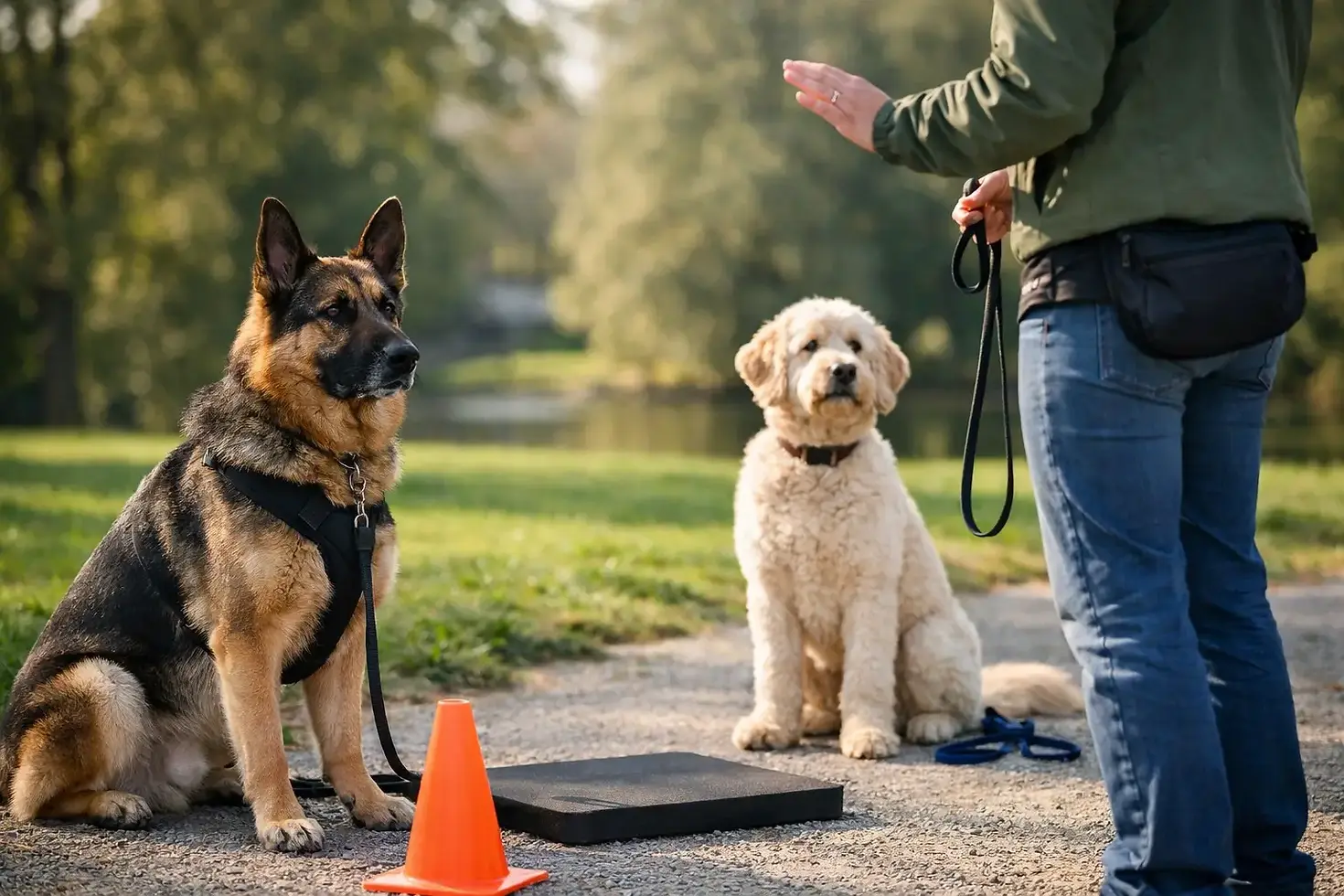
Place is especially useful for dogs that react at windows, doors, or when guests arrive. Instead of allowing frantic pacing and barking, your dog learns to go to a designated bed or platform and remain there until released. That creates a safer routine for everyone and gives your dog a predictable answer to stressful moments.
Leash work matters, too. A tight leash can become a signal that something exciting or alarming is about to happen. Practice walking with a loose leash in quiet areas first. If your dog surges ahead, calmly change direction and bring them back into position. The goal is not a picture-perfect walk for five seconds. The goal is a dog that stays connected to you through movement, stops, and changes in direction.
Do not rush past the basics because your dog already knows how to sit in the kitchen. Real obedience means your dog can follow through around gradually increasing distractions. That is where freedom starts to become possible.
Stop Rehearsing the Behavior at Home
Every time a dog races to the fence line, loses their mind at the front window, or drags an owner toward another dog, they are rehearsing the very behavior you want to change. Management is not the whole solution, but it protects training while better habits are being built.
Block access to windows that trigger nonstop barking. Use a leash or a structured indoor routine when visitors arrive instead of allowing a wild little fur tornado to charge the door. Avoid crowded events, tight sidewalks, and dog-heavy spaces while your dog is still learning. If your dog cannot handle close contact calmly, they do not need to greet every person or dog they see.
That last part can be hard for loving owners. Social does not mean your dog must be friends with everyone. A successful outing may simply mean your dog can walk past another dog without staring, pulling, or exploding. Neutrality is a powerful goal.
Be Consistent Without Becoming Harsh
Dogs do better when the rules are clear. If jumping, pulling, fence fighting, or door rushing is allowed sometimes but corrected other times, your dog is left guessing. Consistency gives them a much fairer path: this behavior does not work, but this calmer behavior does.
Rewards have a place in reactive dog training, especially when marking calm decisions and engagement. Praise, food, play, and access to something your dog enjoys can reinforce the right choice. But relying on treats alone can fall apart when a trigger is more exciting than a snack. Your dog also needs accountability and the ability to follow known commands even when they would rather make another choice.
Accountability should be clear, timely, and appropriate to the individual dog. It is not about intimidating your dog or reacting in anger. It is about interrupting unsafe behavior, guiding your dog back to a known command, and being consistent enough that the lesson makes sense. If you feel frustrated, shorten the session and reset. Training done with a clear head produces better results.
Practice Around Triggers in Controlled Steps
After your dog has dependable obedience in calmer settings, begin carefully adding the real-world situations that cause reactions. This should be structured, not a gamble. Work at a distance where your dog can notice a trigger while remaining responsive to you, then practice focused walking, heel, sit, or place.
As your dog improves, reduce distance gradually or increase the difficulty in small ways. A calm dog across a parking lot may be step one. Passing that dog on the other side of a wide sidewalk may come later. Some dogs progress quickly; others need more time, especially if fear, a long behavior history, or aggression is involved.
Do not force greetings to prove your dog is better. A dog can be well trained and still prefer space from unfamiliar dogs or people. The win is calm, controlled behavior and your ability to safely direct your dog in public and at home.
Know When Professional Help Is the Right Move
Professional support is a smart decision when reactivity is disrupting daily life, creating safety concerns, or leaving you afraid to walk your own dog. It is particularly valuable for dogs with bite history, human aggression, dog aggression, severe anxiety, or reactions that are getting bigger and more frequent.
A qualified trainer can assess patterns you may not see, set up controlled exposure work, and teach you how to handle your dog with confidence. At Top Dog Training Academy, behavior rehabilitation is built around structure, real-world obedience, and practical follow-through so owners can bring the work home and keep it going.
Before starting a training plan, rule out physical discomfort with your veterinarian. Pain, vision changes, thyroid concerns, and other health issues can affect behavior or make a dog less tolerant than usual. Training and veterinary care work best together when both are needed.
Your dog does not need to become the life of every sidewalk to have a good life. With clear rules, steady practice, and the right level of support, the dog who once made every outing feel impossible can learn to move through the world with more calm, control, and freedom.


Comments